
Challenge
PD-L1 expression is one of the most widely used predictive biomarkers in the field of immunotherapy. Patients are deemed eligible for trial enrollment based on their tumor proportion score (TPS) for PD-L1. If PD-L1 TPS is ≥1% or in some cases, ≥50%, patients may be eligible for treatment. But the traditional method of manually scoring PD-L1 immunohistochemistry (IHC) assays can be hindered by high variability, low accuracy and poor sensitivity and could miss eligible patients, resulting in delays during trial enrollment.
This is a widespread challenge; studies have shown that in real-world clinical settings, histologic grading of various tumor types may vary substantially between laboratories1.
Solution
AI-aided scoring may accelerate trial enrollment by detecting very low levels of PD-L1 expression, especially borderline cases at the 1% expression level, which may be missed by the human eye.
In a retrospective study with Merck KGaA, Darmstadt, Germany, we applied our AI-powered PD-L1 TPS algorithm to >100 Non-Small Cell Lung Cancer (NSCLC) IHC samples to aid pathologists’ scoring of PD-L1 expression. We then compared the AI-aided scoring to unaided, manual pathologist scoring.
AI-aided scoring can potentially improve the accuracy of patient classification into clinically meaningful groups, resulting in reclassification of patients previously classified by manual scoring. We utilized our generalizable Area and Cell Lung models which were trained and tested on input data from 11 diverse cohorts (including various labs, antibody clones, staining protocols and scanners) for PD-L1 IHC.
AI-aided scoring recategorized 43% of cases from a ‘treatment-ineligible’ PD-L1-negative group to a PD-L1-positive group. AI-aided scoring of PD-L1 TPS can enable more accurate patient identification for clinical trial enrollment and for treatment selection (Figure 1).
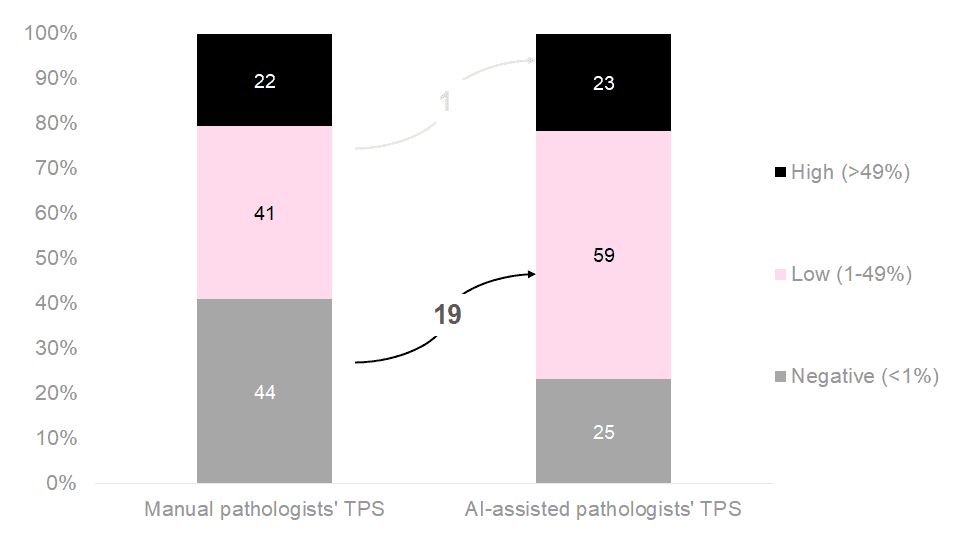
Figure 1: AI-aided scoring recategorized 43% of cases (19 out of 44) from a ‘treatment-ineligible’ PD-L1-negative group to a PD-L1-positive group
Reference:
- Considerable interlaboratory variation in PD-L1 positivity in a nationwide cohort of non-small cell lung cancer patients Koomen, Bregje M. et al. Lung Cancer, Volume 159, 117 – 126