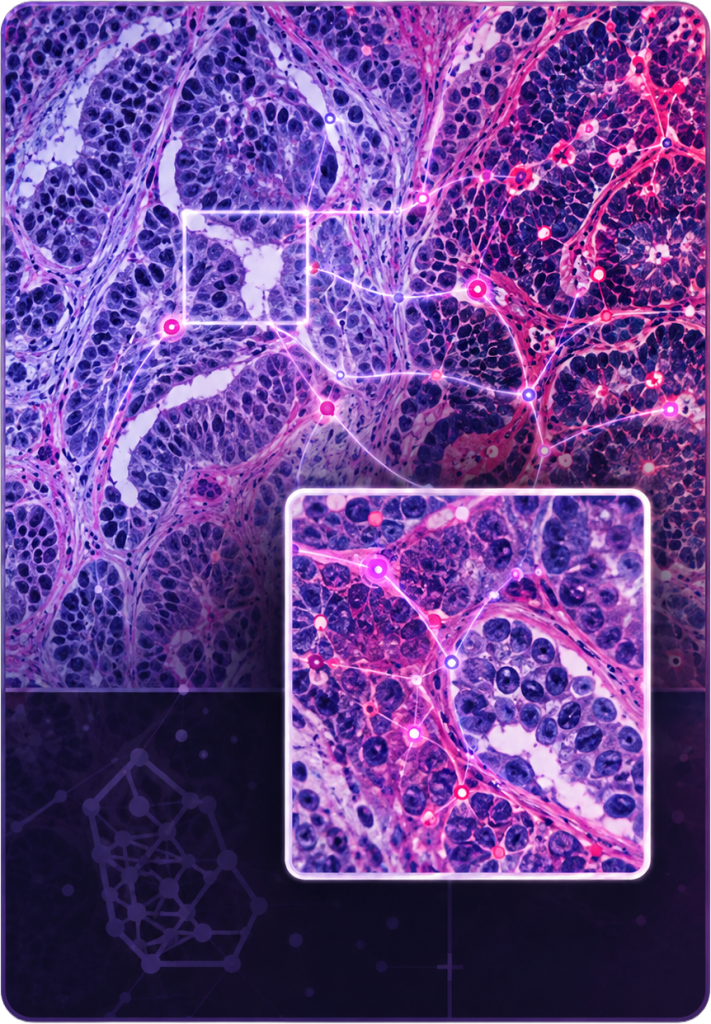

Tissue Intelligence

for every stage of drug development

From the first translational signal to a clinical trial deployment, Nucleai reads tissue across H&E, IHC, multiplex imaging, and spatial transcriptomics, then connects what it finds to clinical outcomes to deliver actionable intelligence for program decisions.

The two questions that drive program decisions

In oncology and other diseases where tissue biology is critical, two questions determine a therapy's path: why does it work, and which patients will benefit. Both answers live in the tissue, but they are hard to reach. The signal is not in any single marker, but in how features are distributed within a sample, how they vary between disease sites, and how they differ from patient to patient.
Nucleai works alongside translational medicine and clinical biomarker teams across the drug development lifecycle, turning tissue images into structured, reproducible evidence, and linking that evidence to clinical outcomes.
Two expert-led service offerings carry that work forward:

For discovery and translational research: from early signal and mechanistic understanding, to biomarker discovery and threshold-setting, to features tested and validated against clinical outcomes.

For patient selection in trials and companion diagnostic development, aligned with regulatory frameworks (CLIA/CAP, IUO/IVD) and governed under Nucleai’s QMS and ISMS (via centralized or distributed deployment).
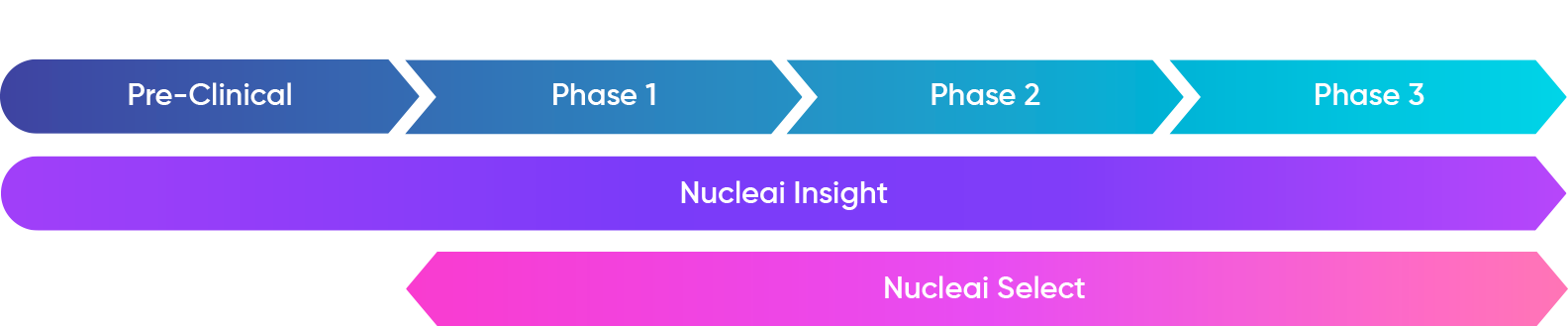

Offerings that span the development lifecycle

Translational Research

Nucleai Insight

Early in a program, the goal is to understand biology: how the drug engages the tumor and its microenvironment, why some tumors respond and others resist, and which spatial features track with benefit. Nucleai Insight quantifies what is on the slide at a depth and consistency that computationally assisted pathologists cannot reach alone, then pairs features across sections and modalities so an entire cohort can be interrogated as one dataset.
When clinical and outcomes data are available, Nucleai tests spatial features and thresholds systematically to establish which ones actually explain response, resistance, and survival.
Delivering at Scale:
In an ongoing collaboration supporting Gilead's global ADC clinical development programs, Nucleai has analyzed thousands of H&E and IHC whole-slide images across multiple oncology indications, connecting tissue biology to clinical outcomes.
Best fit for: Translational medicine and clinical biomarker leaders who need mechanistic understanding, candidate biomarkers, and cohort-scale evidence to guide program decisions.

In collaboration with

Clinical Development

Nucleai Select

As a biomarker matures, the program question shifts to deployment: can it identify the right patients, consistently, across every trial site. Nucleai Select builds a validated spatial biomarker into a deployable scoring algorithm and integrates it into the trial workflow for screening, selection, or enrichment, supporting pathologist scoring with an AI-assisted layer that reduces variability across sites.
The work operates under Nucleai’s certified quality management system (QMS), delivered through established IVD platform and central-lab partners.
Clinical-Grade Deployment:
For a top 10 biopharma sponsor, IHC co-expression algorithms were developed and validated under design controls against pathologist scoring at >85% agreement for clinical cutoffs, and integrated into a CLIA lab viewer to assist pathologist scoring in a prospective deployment of clinical trial assays (CTA). This resulted in 10 validated algorithms across 10 indications.
Best fit for: Clinical biomarker and precision medicine leaders deploying tissue-based selection or enrichment in active trials, with consistency required across sites and geographies.
Companion Diagnostics

Nucleai Select

When a biomarker moves toward the clinic, continuity matters. Nucleai Select is built to carry a validated trial biomarker forward, first as a candidate companion diagnostic, then, working with IVD manufacturer and/or CRO partners who own the regulatory submission, toward an approved companion diagnostic aligned to the drug label. Because the same algorithm partner is designed to run from discovery through trial deployment and into regulatory review, this path reduces bridging efforts related to technology transfer, revalidation, or restart with a new partner.
Best fit for: Precision medicine, CDx development, and regulatory leaders planning the path from a trial biomarker to a commercial IVD.

Certified to Quality & IT Standards

Nucleai's products are designed, developed and deployed utilizing risk-based implementation of our ISO 13485 compliant quality management system as well as our ISO/IEC 27001 compliant information security management system.

A continuous path from discovery to a regulated diagnostic

Proven across the development pipeline

Nucleai's tissue intelligence platform has delivered across real drug-development programs at scale:

Why Nucleai

Most tissue analysis stops at percent positivity and an H-score, a single number that hides biological complexity. Nucleai transforms tissue images into quantitative, spatially resolved biology, with tissue analysis across imaging modalities, systematic linkage to clinical outcomes, and findings that trace to the underlying tissue, interpreted by expert pathologists and scientists—not delivered as raw output.

Multimodal tissue analysis

Outcomes linkage

Traceable output

Regulatory-ready

Ready to Unlock MOre from your Tissue Data?

Talk to an Expert

Discuss how Nucleai can support your research or clinical development program.